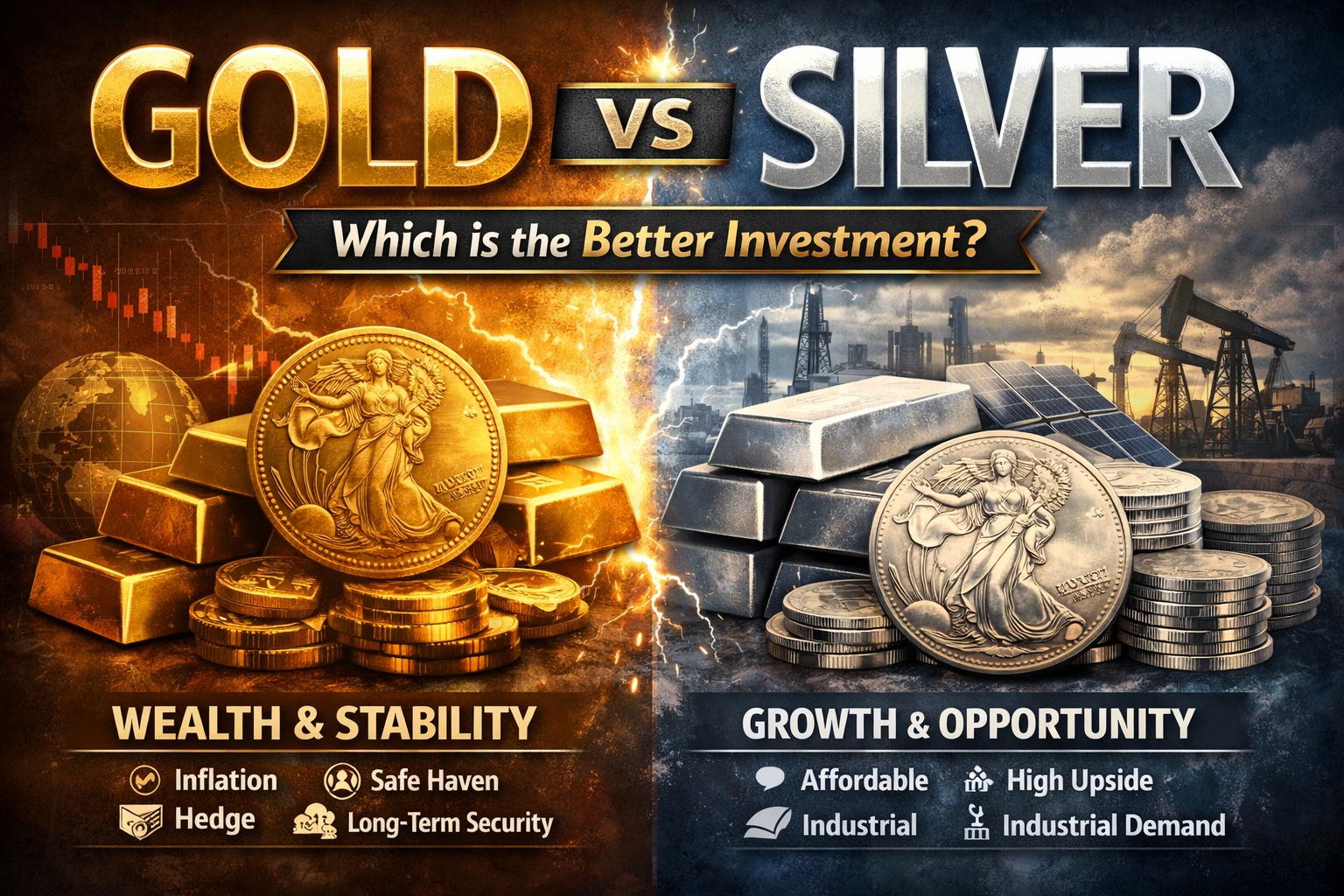

When people start researching how to buy gold and silver online, they’re often overwhelmed by the sheer number of precious metals dealers, confusing pricing structures, and hundreds of different products. From bullion coins to gold bars and silver rounds, it isn’t always clear what offers real value and what simply comes with unnecessary markups.
Most investors want more than just a place to click “buy”, they want to know how to make a smart gold and silver investment that can help protect their money and grow their wealth.
Thats where Precious Metals Growth comes in.
After years of analyzing online gold and silver dealers, pricing tiers, market trends, and investment strategies, I identified the key factors that truly matter when purchasing precious metals. Pricing transparency, dealer reliability, long-term resale value, and market timing signals all play a major role in how your investment performs.
Ignoring any of these could cost you thousands over time.
This guide brings those insights together in one place so you can help avoid costly mistakes and confidently buy gold and silver online more effectively. You’ll learn how to choose reputable bullion dealers, minimize premiums over spot price, recognize valuable market signals, and build a precious metals portfolio designed to help protect your wealth against inflation, market volatility, and currency risk.
Understanding Online Bullion Dealers
The online precious metals market has matured significantly over the past decade into a sophisticated ecosystem. What started as educational platforms around 2011 evolved into full-scale e-commerce operations managing billions in annual transactions.
The transformation from informational websites to complete purchasing platforms happened gradually as dealers recognized that educated buyers wanted streamlined purchasing processes.
SD Bullion launched in March 2012 with the straightforward motto “Nothing Fancy. Just a Telephone and Low Prices” after successfully running a gold and silver education website. The founders recognized that customers who understood precious metals wanted competitive pricing without unnecessary complexity.
Since then, they’ve executed over $5 billion in sales and appeared four times on Inc. Magazines list of 5000 Fastest Growing Companies.
This growth trajectory shows how online bullion retail captured market share from traditional brick-and-mortar coin shops that maintained higher overhead costs and therefore higher premiums.
The industry has consolidated around several major players including BGASC, SD Bullion, JM Bullion, Provident Metals, Golden Eagle Coins, APMEX, Summit Metals, and Bullion.com. Each brings different competitive advantages to their operations.
The consolidation happened naturally as smaller dealers struggled to compete on volume pricing and customer service infrastructure.
BGASC emphasizes shipping speed compared to competitors, positioning themselves as the fast option when you need metals quickly. They’ve built their fulfillment operations around rapid order processing, which matters when you’re trying to lock in pricing during volatile market movements.
Golden Eagle Coins operates with over 50 years of experience dating back to 1974, bringing that legacy dealer credibility to online retail.
They transitioned from traditional retail operations into digital sales while maintaining the reputation they built over decades.
APMEX innovates with rewards integration, offering a “Bullion Card” that returns 4% cash-back in actual precious metals instead of dollars. This approach converts transaction fees into metal accumulation, which changes the economics of credit card purchasing.
Traditional wisdom suggests paying by wire transfer or check to minimize costs, but a 4% metal return may offset payment processing premiums.
What you’ll notice across all major dealers is BBB accreditation and verified customer reviews. Golden Eagle Coins has accumulated over 29,800 verified reviews with a 4.8 rating, which gives you some confidence that these aren’t fly-by-night operations.
The verification systems prevent fake review manipulation while providing transparency into actual customer experiences.
The industry has legitimized itself through customer protection standards that were honestly less common in the early days of bullion retail. Insurance coverage, secure packaging, and formal complaint resolution processes now represent standard operating procedures as opposed to competitive differentiators.
Product Categories That Actually Matter
Government mint products dominate the online bullion space for several practical reasons. American Silver Eagles and American Gold Eagles remain the most popular offerings because they carry government backing and maintain consistent premiums across market cycles.
The United States Mint produces these coins with guaranteed weight and purity, removing authentication concerns that exist with less-established products.
Canadian Gold Maple Leafs, South African Krugerrands, and Mexican Silver Libertads round out the government-backed options that typically offer easier resale liquidity than generic products. When you eventually decide to sell your metals, dealers immediately recognize these products and offer competitive buyback pricing without requiring authentication testing.
This liquidity advantage matters significantly when you need to convert metals back into currency quickly.
Generic bullion from private mints offers identical precious metals content at noticeably lower premiums. Gold bars and silver rounds from operations like Scottsdale Mint or Kinesis Mint give you the same ounces of gold or silver without the government backing premium.
The metal content undergoes the same refining processes and meets the same purity standards as government products.
The premium difference exists purely because of brand recognition and government guarantee as opposed to actual metal quality.
If your primary goal involves accumulating metal weight as opposed to collector appeal, generic products often make more economic sense. The premium you pay above spot price represents permanent cost that you’ll never recover when selling.
Minimizing this premium through generic product selection increases the percentage of your investment actually allocated to metal value.
For investors focused on commodity exposure as opposed to numismatic collecting, this distinction becomes financially significant.
Numismatic coins operate on a completely different valuation framework from bullion products. PCGS and NGC graded coins like Morgan Dollars, Peace Dollars, or pre-1933 gold pieces command premiums based on rarity, condition, and collector demand as opposed to spot price alone.
The grading services encapsulate coins in tamper-evident holders with condition ratings that determine market value.
A Morgan Dollar might contain one ounce of silver now worth $30, but trade for hundreds or thousands of dollars based on date, mint mark, and condition grade.
These products function as collectibles that happen to contain precious metals as opposed to pure commodity investments. The spreads between purchase and sale prices run significantly wider than bullion products, and the market involves more specialized knowledge about grading standards and rarity factors.
Appreciation potential comes from collector dynamics and numismatic market trends as opposed to commodity price movements.
Unless you develop expertise in numismatics or genuinely enjoy collecting, these products complicate your investment strategy without necessarily improving returns.
Fractional products represent a genuinely important accessibility shift in the precious metals market. One-gram gold bars and one-tenth ounce gold eagles allow smaller investors to dollar-cost-average into precious metals without waiting to accumulate thousands of dollars.
Previously, bullion investing required significant upfront capital that created barriers for beginning investors or those implementing systematic accumulation strategies.
These micro-denominations democratize access to gold ownership, though they do carry higher per-ounce premiums because of manufacturing and handling costs. Producing and packaging a one-gram gold bar needs similar labor and materials as a one-ounce bar but yields far less revenue per unit.
Dealers pass these economics along to customers through higher percentage premiums on small denominations.
You’ll pay this accessibility premium in exchange for flexibility in position sizing and accumulation timing.
Pricing Structures You Need to Understand
Volume-based tiering creates surprisingly significant per-ounce savings at specific quantity thresholds. This pricing architecture exists across virtually all major dealers with minor variations in exact break points.
A typical structure breaks down like this: small orders of one to nineteen units carry baseline pricing with the highest per-unit cost.
When you jump to twenty to ninety-nine units, you’ll see fifty cents to a dollar per ounce discount applied automatically.
Bulk orders of one hundred to four hundred ninety-nine units add another dollar to two dollars per ounce savings beyond the baseline price. Large orders of five hundred to fourteen hundred ninety-nine units reduce costs by two to four dollars per ounce compared to small quantity pricing.
Institutional orders of fifteen hundred plus units get most discount schedules that can reduce per-ounce costs by five dollars or more.
The practical implication means purchasing twenty units instead of ten may reduce your per-ounce costs by amounts equivalent to significant spot price movements. You might spend weeks watching spot prices hoping to catch a two percent decline, while volume optimization can deliver similar or better savings instantly.
This creates real incentives for consortium buying among family members or friends, or strategic timing of your own accumulation to consolidate purchases at threshold quantities.
If you’re planning to accumulate a certain amount over six months anyway, consolidating into fewer larger orders as opposed to many small ones may save you substantial amounts. The savings compound over time and across many purchases.
Running the actual numbers on your planned accumulation schedule reveals how much volume optimization can improve your effective acquisition costs without requiring any market timing skill.
Payment method selection impacts your final cost more than most buyers initially realize. Wire transfers and checks typically receive the lowest rates because they involve minimal processing costs and no chargeback risk for dealers.
Credit card payments incur higher costs ranging from twenty cents to a dollar per ounce depending on order size.
The spread exists because credit card processors charge merchants percentage-based fees that get passed along to customers through higher product pricing.
For large orders, this routing decision becomes tactically significant. A one percent difference on a twenty-thousand-dollar purchase equals two hundred dollars in additional cost.
The inconvenience of setting up a wire transfer suddenly seems worthwhile when you quantify the actual dollar savings.
Of course, if you’re using something like APMEXs Bullion Card that returns 4% in precious metals, the calculation changes since you’re earning metal back on the purchase that may exceed the payment method premium.
Free shipping thresholds typically start at $199 across most major dealers, though some like Golden Eagle Coins offer it at $99 and others charge $9.95 for smaller orders. All major dealers include insurance in their shipping costs, protecting against loss or damage during transit.
They use discreet packaging through USPS or equivalent carriers without external markings indicating precious metals contents.
Shipping speed has emerged as a competitive differentiation factor recently, with dealers explicitly promoting faster fulfillment compared to competitors. BGASC particularly emphasizes this advantage in their marketing positioning.
The speed matters when you lock in pricing during an order and want physical possession quickly, or when you’re purchasing near market lows and want to capture the timing advantage fully.
Market Signals Some Investors Miss
Silver has recently traded above $67 per ounce in certain contexts, achieving a notable threshold where a single ounce has purchased an entire barrel of oil. This silver-to-oil ratio parity represents a rare occurrence that has not been common in recent decades.
Historical data on this relationship shows that during past instances of this ratio, silver subsequently appreciated relative to oil pricing. However, past performance does not guarantee future results, and commodity markets can behave differently across various cycles.
**Analysis of commodity ratios by some market observers suggests these relationships tend to fluctuate through market cycles rather than remaining stable. When silver has achieved parity with oil in the past, the relationship has sometimes extended further.
This historical pattern may indicate potential momentum, though market conditions can vary significantly.**
Some market participants believe that institutional perspectives on this signal may differ from retail investor awareness. This could create information differences in price discovery where certain players understand historical implications differently than others.
**The relationship between silver and oil prices may suggest market dynamics worth monitoring. Either silver could be underpriced relative to oil, or oil could be overvalued relative to silver.
Monitoring which commodity adjusts could provide insights for both metals and energy positions.**
Chinas strategic positioning in precious metals markets represents another factor affecting global supply that some analysts are watching. Beyond visible pricing and supply metrics, China maintains substantial involvement in global silver refining and processing infrastructure.
Market analysis suggests that export controls on precious metals could potentially affect global supply availability. Such policy changes might impact premiums, though the timing and extent of any effects stay uncertain.
Export controls could gradually influence global availability through mechanisms that initially get absorbed by existing inventory buffers. The effects on pricing may become obvious over time as supply dynamics adjust.
Geopolitical developments can create supply factors independent of mining production or investment demand fundamentals. Investors who monitor policy developments alongside market pricing may gain additional perspectives over those focused exclusively on current market pricing.
Strategic Purchasing Approaches
Order timing and volume optimization genuinely matter when you understand the tiered pricing structure. Individual buyers may reduce per-ounce costs by several percentage points through volume optimization alone, which can be equivalent to catching favorable spot price movements.
If you’re accumulating precious metals systematically, planning your purchases around quantity thresholds makes genuine economic sense as opposed to buying arbitrary amounts whenever funds become available.
Calculate your target accumulation for the next six to twelve months, then reverse-engineer optimal purchase quantities that align with dealer volume tiers. This approach changes random purchases into strategic acquisitions that can minimize lifetime acquisition costs.
The discipline required to wait for optimal purchase quantities as opposed to buying impulsively can improve your average cost basis significantly.
Product mix strategy involves balancing government mint products that offer relatively lower premiums and higher liquidity with numismatic coins that provide collector appeal and potentially higher appreciation. Most serious precious metals portfolios mix both approaches as opposed to exclusively focusing on one product category.
The allocation between categories depends on your specific goals and market outlook.
Government mint products provide reliable liquidity and tight bid-ask spreads that make them suitable for your core holdings. These products function as true commodity exposure with minimal premiums over spot price.
Numismatic pieces add upside potential from collector dynamics that operate independently of spot price movements.
Including select numismatic products may enhance returns if you develop enough expertise to identify undervalued items.
Dealer relationship building might sound old-fashioned in an e-commerce context, but established dealers offer phone support that allows negotiation on large orders or bulk purchases. Direct dealer contact sometimes yields pricing improvements unavailable through online interfaces.
This particularly applies to orders approaching or exceeding institutional thresholds where custom pricing arrangements become possible.
Building rapport with specific sales representatives at major dealers creates advantages when you need assistance with special requests or pricing negotiations. While online interfaces provide transparency and convenience for standard orders, phone contact enables flexibility that automated systems can’t accommodate.
For substantial purchases, investing time in dealer relationships may save considerable amounts through negotiated pricing.
Spot price monitoring across multiple dealers identifies pricing inefficiencies that you can exploit through strategic purchasing. Live spot price tracking on dealer websites updates in real-time, but premium structures over spot vary between dealers for identical products.
Minor discrepancies between dealers on the same product occur regularly, especially during volatile market periods.
When you’re making substantial purchases, checking pricing across three or four major dealers before clicking “buy” can save meaningful amounts. Set up browser tabs for BGASC, SD Bullion, Golden Eagle Coins, and APMEX, then compare pricing for your intended purchase quantity.
The few minutes spent comparison shopping may save notable percentages on total order value.
Common Problems and How to Avoid Them
Counterfeiting and authenticity concerns legitimately exist in precious metals markets, though established dealers mitigate this risk through direct mint relationships and careful inventory inspection. JM Bullion specifically emphasizes quality control through comprehensive inventory inspection that catches counterfeit products before reaching customers.
Established dealers maintain relationships directly with government mints and major private refiners, reducing counterfeit exposure in their supply chains.
Newer or less-established dealers present higher authentication risk because they may source inventory through secondary markets with less supply chain transparency. Making dealer selection based partially on establishment history and customer review volume provides some assurance.
While counterfeiting risk can never reach absolute zero, buying from major dealers with extensive track records reduces this concern to minimal levels.
Dealer insolvency represents counterparty risk that’s easy to overlook when you’re focused on product selection and pricing. BBB accreditation and transaction history provide imperfect but meaningful signals of dealer financial stability.
Long-established operations like Golden Eagle Coins operating since 1974 present lower counterparty risk than newer dealers without extensive track records.
You’re essentially trusting the dealer to actually ship your metals after payment clears, creating counterparty exposure during the fulfillment window. Dealer reputation and financial stability matter significantly for peace of mind.
Major dealers process thousands of orders weekly with established fulfillment operations, making operational failure unlikely.
Still, understanding this counterparty risk encourages dealer selection based on stability as opposed to marginal pricing differences.
Liquidity and buyback spreads vary significantly by dealer and product type when you eventually decide to sell. All major dealers now operate precious metals buyback programs, but the spreads between purchase and sale prices can run substantial.
Generic bullion typically features tighter spreads than numismatic coins, which impacts your effective returns across the complete purchase-hold-sell cycle.
Understanding buyback spreads before purchasing helps set realistic expectations for eventual liquidation. Call dealers to ask buyback quotes on products you’re considering purchasing, then calculate the round-trip transaction cost including both purchase premiums and sale discounts from spot.
This analysis reveals the spot price appreciation required to achieve breakeven, which grounds your return expectations in realistic economics.
Storage and insurance costs often get overlooked in initial purchase decisions. Dealers facilitate delivery of physical bullion but don’t provide long-term storage solutions unless you specifically arrange vault storage services.
You’ll need to arrange private storage, safe deposit boxes, or paid vault services, each with associated costs and security tradeoffs.
Safe deposit boxes at banks cost anywhere from fifty to three hundred dollars annually depending on size and location. Home safes need upfront investment ranging from two hundred to several thousand dollars plus potentially higher homeowners insurance premiums.
Professional allocated storage at specialized vaults provides institutional-grade security but adds ongoing costs typically calculated as percentage of holdings value.
These storage costs impact your effective return and deserve consideration during purchase planning. If storage costs one percent of holdings value annually, you need one percent spot price appreciation just to offset storage before achieving any real return.
Understanding total ownership costs beyond acquisition pricing prevents unwelcome surprises and enables accurate return calculation.
Tax implications vary significantly by jurisdiction and purchase size. Some states impose sales tax on precious metals purchases below certain thresholds, while others exempt bullion entirely.
Minimum purchase amounts for tax exemption typically range from one thousand to fifteen hundred dollars depending on state regulations.
Large purchases may trigger reporting requirements under federal law through dealer Form 1099-B filing.
Understanding your specific tax situation before making substantial purchases prevents unwelcome surprises at tax filing time. Consult with tax professionals regarding precious metals taxation in your jurisdiction, including purchase sales tax, capital gains treatment on disposition, and reporting thresholds that trigger dealer notifications to tax authorities.
This due diligence enables tax-efficient structuring of your metals accumulation strategy.
People Also Asked
What is the cheapest way to buy gold and silver online?
The cheapest way involves maximizing volume discounts by consolidating purchases at dealer tier thresholds, paying by wire transfer or check to avoid credit card premiums, and selecting generic bullion products over government mint coins to minimize premiums above spot price. Comparing pricing across multiple major dealers before each purchase may capture any temporary pricing inefficiencies between platforms.
Is it safe to buy precious metals online?
Buying from established BBB-accredited dealers with extensive customer reviews provides comparable safety to traditional retail purchases. Major online dealers include full insurance on shipments, use discreet packaging, and maintain secure payment processing.
The primary risks involve dealer insolvency before shipping or receiving counterfeit products, both mitigated by selecting dealers with long operating histories and direct mint relationships.
Do I have to pay taxes when I buy gold and silver?
Sales tax requirements vary by state, with many states exempting precious metals purchases above certain thresholds typically ranging from one thousand to fifteen hundred dollars. Purchase itself doesn’t trigger federal income tax, but eventual sale creates potential capital gains tax liability based on appreciation during your holding period.
Some states impose no sales tax on any bullion purchases regardless of amount.
What is the best online dealer for buying silver?
The best dealer depends on your specific priorities including pricing, shipping speed, product selection, and payment options. SD Bullion and BGASC consistently offer competitive pricing on generic silver, while APMEX provides extensive product selection and rewards programs.
Golden Eagle Coins brings decades of dealer reputation, while smaller orders might find better shipping thresholds at dealers with lower minimum free shipping amounts.
Should I buy government mint coins or generic bullion?
Government mint coins offer higher liquidity and consistent premiums but cost more upfront. Generic bullion minimizes premiums above spot price but may face slightly wider bid-ask spreads when selling.
For investors focused on accumulating metal weight as commodity exposure, generic products deliver better economics.
For those prioritizing resale ease and universal recognition, government products justify their premium.
How much silver should I buy as a beginner?
Start with quantities that let you reach dealer volume discounts without overextending your budget, typically twenty to fifty ounces of silver to access first-tier volume pricing. This provides meaningful exposure to silver price movements while keeping total investment moderate during your learning phase.
Dollar-cost averaging through regular purchases at volume tier thresholds builds positions systematically regardless of short-term price movements.
Can I store precious metals at the dealer?
Some major dealers offer allocated storage services where your specific metals remain segregated in professional vaults. This service typically costs annual fees calculated as percentage of holdings value, usually ranging from 0.5% to 1.5% depending on total value stored. Allocated storage eliminates home security concerns but adds ongoing costs and creates counterparty risk if the dealer or vault operator encounters financial problems.
What is the best time to buy gold and silver?
Optimal timing involves monitoring both price levels and cross-commodity relationships like silver-to-gold ratios and silver-to-oil ratios that may signal relative value. Precious metals have historically appreciated during periods of currency devaluation, financial system stress, and rising inflation, though past performance does not guarantee future results.
Rather than attempting perfect timing, systematic accumulation through dollar-cost averaging at volume discount thresholds often produces favorable results compared to trying to time absolute market bottoms.
Key Takeaways
The online precious metals market has consolidated around several major BBB-accredited dealers offering competitive pricing, rapid shipping, and buyback programs that provide genuine liquidity for eventual sales.
Volume-based pricing tiers create substantial per-ounce savings at specific quantity thresholds, making order consolidation and strategic timing economically significant for potentially reducing effective costs by several percentage points.
The recent silver-oil ratio parity represents a historically notable occurrence that some market observers believe may indicate silver pricing dynamics relative to traditional commodities, though future price movements stay uncertain and past patterns do not guarantee similar outcomes.
China’s strategic presence in global silver refining and policy developments regarding export controls could potentially affect supply availability, favoring investors who monitor geopolitical developments alongside market pricing, though the extent and timing of any impacts stay uncertain.
Government mint products balance premium stability with universal liquidity, while generic bullion minimizes premiums and numismatic coins add collector upside, requiring product mix strategies aligned with specific investment goals and time horizons.